Take no part in the unfruitful works of darkness, but instead expose them. For it is shameful even to speak of the things that they do in secret. But when anything is exposed by the light, it becomes visible, for anything that becomes visible is light.
I’ve recently realized how profoundly my life has been impacted by the (generally) very quiet presence of a “hidden box of shame.” Let me explain that phrase by expanding it one word at a time.
First, “shame” is distinguished from guilt. Guilt has to do with knowledge of having violated a law (either human or spiritual), i.e. having committed a crime, and hence being susceptible to punishment which then gives rise to fear. Shame is less legal/formal and more personal. It has to do with a sense of feeling dirty, exposed/naked, stupid/foolish, and worthy of rejection. Whereas a judge will pass sentence on your guilt, the consequences of shame may include having your community scorn, mock, disdain, and cut you off (at least from the inner circle of close, intimate fellowship).
Shame’s sense of filth and unworthiness, and its expectation (and/or reality) of social ostracization, are extremely unpleasant, even terrifying and traumatizing at times.
Hence, at least speaking for myself, I have an inner “box of shame” in which to cram all shame-related thoughts, feelings, and memories. The box has a lid and a padlock which I desperately seek to keep shut. I certainly don’t want other people looking or tinkering around in that box, but I don’t even want to look in there myself.
Which brings us to the final, and perhaps most crucial, word in today’s phrase: hidden. Not only do I cram my shame into the box and lock it down, but then I hide the box in some inner closet and try to forget that it even exists. Sadly and ironically, that very act of hiding my box of shame is the very thing that has given it super powers over my life. Ignoring its existence allows it to exercise its control over my affections and behavior unhindered. I never say even to myself, much less to others, “I’m responding in this unhealthy way because I’m terrified of something leaking out of my shame box.” Instead, I wield one of the trauma response mechanisms in a desperate attempt to get the issue to disappear as soon as possible so I can return to a state of blissful ignorance that my hidden box of shame even exists.
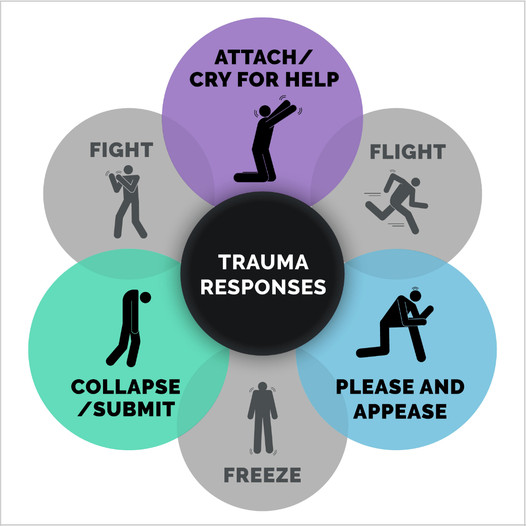
[Credit to NICABM for the infographic.]
Like a drug addiction, therefore, the hidden box of shame keeps me in a state of dependency on those base trauma responses in order to balm and soothe the terror that is activated by momentary glimpses of the dreadful specimens which occasionally spring out of the box. Meanwhile, keeping this box hidden from my own sight (all the more so from the sight of others), leaves me oblivious to the fact that these controlling dynamics are at work in various ways to wreak havoc on my life.
 hasteningthecomingofthedayofGod
Leave a comment