When the Spirit of God looked upon the church of Ephesus and saw that they had “abandoned the love [they] had at first” (Rev 2:4), precisely what declension in action, attitude, thought, and/or behavior did He actually see among them? Was it simply an intensity gauge — their love for the Lord and/or for each other1 was not as strong as it once had been? Or had some other object of affection overtaken Christ’s position as “first love” in their hearts? This very succinct letter to the angel of the church in Revelation 2:1-7 does not explicitly say. However, I believe that the full counsel of Scripture does provide further insight into the situation.
The direct consequence of unrepentance for abandonment of first love was that the Ephesian lampstand would be removed from its place (vs 5). Now, the primary interpretive key for understanding Revelation as a whole is that it constantly makes use of allusions to other parts of the Old Testament, to other Judaic literature, and to well-known themes from the historical context, to tie up the whole Biblical storyline into one intricately interwoven package! “Jesus among the golden lampstands” in Revelation 1 clearly intends to picture a Great High Priest among the golden menorah(s) of the Tabernacle/Temple. And someone hearing about such lampstands being “removed from their place” would have not one but three parallel historic precedents to map that concept onto:
- Nebuchadnezzar deported all the “vessels of the house of God” to Babylon when He conquered Jerusalem (2 Kings 24:13, 25:13–15, 2 Chr 36:7, 10, 18, Ezra 1:7–11, 5:14, 6:5, Jer 27:16–22, 28:3, 6, Dan 1:2, 5:2–3) in ~587BC.
- Antiochus IV Ephiphanes took all the vessels, including the golden candlesticks, when he plundered the Temple (1 Macc 1:23 and Josephus, Antiquities of the Jews, XII.5.4) in 167BC.
- The Arch of Titus which still stands in Rome depicts him carting off the Temple Menorah after squashing the First Jewish Revolt in AD70:
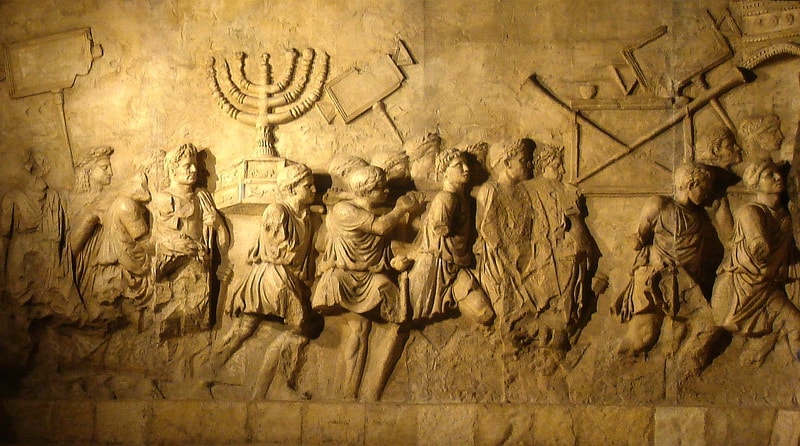
In sum, a clear pattern is evident. When God is sufficiently displeased with the waywardness of His people, He gives His holy city over to their enemies who come in, plunder His house, and take its vessels for their own purposes. Revelation 2:5 expects the attentive listener to already have that background knowledge in mental storage, and then with that one little phrase, “remove your lampstand from its place,” the text activates all of those associations in the front registers of your mind.
So now, all of a sudden, the context of Rev 2:4-5 is not just a small handful of verses immediately preceding and following it, but also a web of much broader and deeper intertextual and historical connections.2 By looking at what led Israel to lose her lampstand on each of these three distinct occasions, we can gain insight into why the same God warned the church of Ephesus that they were poised to lose theirs!
Moreover, the book of Revelation itself also circles back to prophetically tell more of the “lampstands in peril” story. In chapter 11, “the nations” come and “trample” the holy city. Doesn’t that sound familiar? And immediately thereafter we read an account of the activity of some figures who/which go by multiple labels including “two lampstands.” So after the “trampling” of the “holy city” our “seven golden lampstands” are reduced down to “two lampstands.” Sounds like five lampstands got removed from their place.
Of the two lampstands which remain, what useful light-shining role do they continue to fulfill? In the spirit of Moses and Elijah, they testify with boldness and power that YHWH alone is God and King over all the earth. God grants these “two witnesses” — who fulfill the minimum legal requirement for sentencing a criminal to execution (Deut 17:6, etc.) — authority for a period of three and a half years (1,260 days).
Meanwhile, what has happened to the other five lampstands? They have been taken into Babylonian captivity (chp. 17-18) by “the nations” who have been granted their own share of authority for an analogous three and a half year period (42 months). Revelation 12-14 provides the character development that enriches the short story in chapter 11. So in 13:5 we circle back to this same “forty-two months” hyperlink, in which the immediate context portrays the demonic force behind the “nations” that trample the holy city as a persecutorial “beast rising out of the sea” which amalgamates the four hostile kingdoms of Daniel 7. And it is right here that we get another clear nugget of revelation into how the Ephesian lampstand was likely failing in its special apostolic vocation.
God allows “five” lampstands to be plundered by the beastly nations for 42 months in chapter 11 because they grant worship-worthy reverence to other powers and authorities rather than to Christ alone. How do I conclude that? Because the participle in Revelation 13:4 is epexegetical. In short, “they worshiped the beast, [by] saying, `Who is like the beast, and who can fight against it?’,” means that unwillingness to “fight against” the beast is functionally equivalent to worshipping the beast. Numerous Christian worship songs declare, “I surrender all …,” etc. We sing such things becaues you surrender to a power greater than yourself. You surrender to something that you have no chance to withstand given both your own resources and those which you expect to come to your aid. You surrender to that which has insurmountable god-like power relative to you. You surrender to something worthy of your adoration.
The five (implicitly) plundered lampstands say, “Who can fight against the beast?” They ask this question rhetorically, certainly no one can fight against such a beast! Standing before the face of the beast, they have hidden their own light under a bowl. Probably without realizing it, they are performing an act of worship by laying their weapons of warfare at their captors’ feet. And yet the “two lampstands” which remain have a substantive answer to the same rhetorical question. They say, “Under the command of the Second Adam who has all authority in heaven and on earth, we His martyr-army of devoted-virgin witnesses are not only able to ‘fight’ against the beast, but indeed we conquer/overcome beasts by the blood of the Lamb and the word of our testimony” (cmp. Rev 12:11).
In sum, then, the church of Ephesus “forsook their first love” when they began to view other powers — human and/or demonic — as more awe-inspiring, more worthy of reverence, than King Jesus Himself. Their unwillingness to openly testify to the Son of God in the face of hostile persecution demonstrated that their affections did not belong exclusively to Him. In short, they had become beast-worshippers.
Interestingly, Greg Beale arrives at effectively the same conclusion along an entirely different exegetical route (emphasis in original):
Although they were ever on guard to maintain the purity of the apostolic teaching, the Ephesian Christians were not diligent in witnessing to the same faith in the outside world … The idea is that they no longer expressed their former zealous love for Jesus by witnessing to him in the world. This is why Christ chooses to introduce himself as he does in v 1. His statement that he “walks in the midst of the seven golden lampstands” is intended to remind the introverted readers that their primary role in relation to their Lord should be that of a light of witness to the outside world.
That losing their “first love” was tantamount to becoming unzealous witnesses is suggested further as we see a link with Matt. 24:12–14, which shows such an end-time expectation: “Most people’s love will grow cold. But the one who endures to the end will be saved. And this gospel of the kingdom will be preached in the whole world for a witness to all the nations, and then the end will come.” This explains the loss of love as unfaithfulness to the covenantal task of enduring in preaching the gospel “for a witness.” Indeed, this is to occur together with an increase in “false prophets” who will “mislead” (Matt. 24:10–11, 23–26), just as was occurring in Ephesus.
Confirmation of the same principle via independent arguments provides robust validation that Scripture has indeed provided us insight regarding at least one kind of first-love abandonment which results in loss of lampstand. Beale one more time, “among the warnings of judgment in the letters this one is unique to the letter to Ephesus and is especially suited in a lex talionis manner to their role as light-bearers: if they will not exercise their call to be a lamp of witness, then their lamp will be removed, as with Israel in the OT.” The fact that a scary beast threatens to kill you does not nullify the “call to be a lamp of witness.” The lampstands did not have their light stolen from them; they voluntarily allowed it to go out or to be hidden under a bowl. Lampstands that don’t shine forth visible light are like unsalty salt; useful only to be trampled upon.
Footnotes
- “The point is not primarily that they had lost their love for one another, as argued by most commentators (e.g., Moffatt’s translation, “you have given up loving one another as you did at first”)” (Beale, G. K. The Book of Revelation: A Commentary on the Greek Text. W.B. Eerdmans; Paternoster Press, 1999, p. 230). ↩︎
- Referred to as “horizontal context” and “vertical context,” respectively, in: Schnittjer, Gary Edward, and Matthew S. Harmon. How to Study the Bible’s Use of the Bible: Seven Hermeneutical Choices for the Old and New Testaments. Zondervan Academic, 2024. ↩︎
ChatGPT’s Turkish translation
ChatGPT’nin Türkçe çevirisi
Terk Edilen Sevgi ve Yerinden Kaldırılan Kandillikler
Tanrı’nın Ruhu, Efes’teki kiliseye bakıp onların “ilk sevgilerini terk ettiklerini” gördüğünde (Vahiy 2:4), aslında tam olarak ne görüyordu? Eylemde, tutumda, düşüncede ya da davranışta ne tür bir gerileme söz konusuydu? Bu sadece bir yoğunluk meselesi miydi—Rab’be ve/veya birbirlerine olan sevgileri eskisi kadar güçlü değildi mi? Yoksa Mesih’in yüreklerindeki “ilk sevgi” konumunu başka bir sevgi nesnesi mi ele geçirmişti? Vahiy 2:1–7’de kilisenin meleğine yazılan bu son derece kısa mektup bunu açıkça söylemez. Ancak Kutsal Yazıların bütünü, bu duruma dair daha derin bir içgörü sunar kanaatindeyim.
İlk sevgiyi terk edip tövbe etmemenin doğrudan sonucu, Efes’in kandilliğinin yerinden kaldırılmasıydı (ayet 5). Vahiy kitabını anlamanın temel anahtarı şudur: Metin sürekli olarak Eski Antlaşma’nın diğer bölümlerine, Yahudi yazın geleneğine ve tarihsel bağlamdaki bilinen temalara göndermeler yaparak tüm Kutsal Kitap anlatısını tek, iç içe geçmiş bir bütün hâline getirir. Vahiy 1’deki “altın kandillikler arasında yürüyen İsa” sahnesi, açıkça Tapınak’taki/Çadır’daki altın şamdanlar (menora) arasında bulunan başkâhini çağrıştırır. Böyle bir bağlamda “kandilliğin yerinden kaldırılması” ifadesini duyan biri, bunu en az üç tarihsel örnekle ilişkilendirebilirdi:
- Nebukadnessar, Yeruşalim’i fethettiğinde “RAB’bin Tapınağı’nın kap kacaklarını” Babil’e sürgün etti (MÖ ~587).
- Antiochus IV Epiphanes, Tapınağı yağmaladığında altın şamdanlar dâhil tüm kapları aldı (MÖ 167).
- Roma’daki Titus Kemeri, MS 70’te Tapınak’ın menorasının götürülüşünü hâlâ tasvir eder:
Özetle açık bir örüntü var: Tanrı, halkının sapkınlığından yeterince hoşnutsuz olduğunda kutsal kenti düşmanlarına teslim eder; onlar gelir, Tanrı’nın evini yağmalar ve kaplarını kendi amaçları için götürür. Vahiy 2:5, dikkatli okuyucunun bu arka planı zaten bildiğini varsayar ve “kandilliğini yerinden kaldırırım” ifadesiyle bütün bu çağrışımları zihinde harekete geçirir.
Böylece Vahiy 2:4–5’in bağlamı sadece çevresindeki birkaç ayet değil, çok daha geniş ve derin bir metinlerarası ve tarihsel ağ hâline gelir. İsrail’in bu üç olayda kandilliğini kaybetmesine yol açan sebeplere bakarak, aynı Tanrı’nın Efes kilisesini neden aynı tehlike konusunda uyardığını anlayabiliriz.
Ayrıca Vahiy kitabı, “tehlike altındaki kandillikler” temasını ilerleyen bölümlerde peygamberlik diliyle yeniden işler. 11. bölümde “uluslar” kutsal kenti “çiğner.” Tanıdık geliyor mu? Hemen ardından, “iki kandillik” diye de anılan figürlerin faaliyetleri anlatılır. Yani kutsal kentin çiğnenmesinden sonra yedi altın kandillik ikiye düşmüştür—beşi yerinden kaldırılmış gibidir.
Geriye kalan bu iki kandillik ne yapar? Musa ve İlyas’ın ruhu ve gücüyle, yalnızca Yahve’nin tüm yeryüzünün Tanrısı ve Kralı olduğunu cesaretle ilan ederler. Bu “iki tanık,” bir suçlunun ölüm cezasına çarptırılması için gerekli en az tanık sayısını (Yas. 17:6 vb.) karşılayarak, üç buçuk yıl (1.260 gün) boyunca yetkiyle tanıklık eder.
Peki diğer beş kandilliğe ne oldu? Onlar, yine yaklaşık üç buçuk yıllık (42 ay) bir süre için yetki verilmiş olan “uluslar” tarafından Babil benzeri bir esarete sürüklenmiştir (bölüm 17–18). Vahiy 12–14, 11. bölümdeki kısa anlatıyı karakter gelişimiyle zenginleştirir. 13:5’te aynı “kırk iki ay” temasına geri dönülür; burada kutsal kenti çiğneyen ulusların ardındaki ruhsal güç, Daniel 7’deki dört krallığın birleşimi gibi tasvir edilen “denizden çıkan canavar”dır. Tam bu noktada, Efes kandilliğinin muhtemel başarısızlığına dair önemli bir ipucu daha elde ederiz.
Tanrı, 11. bölümde beş kandilliğin 42 ay boyunca bu canavarî uluslar tarafından yağmalanmasına izin verir; çünkü onlar, Mesih’e özgü olan tapınma saygısını başka güç ve otoritelere yöneltirler. Bunu nasıl çıkarıyorum? Çünkü Vahiy 13:4’teki ifade açıklayıcıdır: “Canavara tapındılar; ‘Canavar gibi kim var? Ona kim karşı koyabilir?’ dediler.” Yani canavara karşı koyma isteksizliği, fiilen ona tapınmakla eşdeğerdir. Birçok ilahide “Her şeyimi sana teslim ediyorum…” deriz. Çünkü insan, kendisinden daha güçlü olana teslim olur. Karşı koyamayacağına inandığı güce boyun eğer. Bu, ilahi güce atfedilen bir değer yargısıdır—bir tür tapınmadır.
Yağmalanan beş kandillik, “Canavara kim karşı koyabilir?” diye sorar. Bu retorik sorunun cevabı onlara göre bellidir: kimse. Canavarın karşısında kendi ışıklarını gizlemişlerdir. Belki farkında olmadan, silahlarını düşmanın önüne bırakarak bir tür tapınma eylemi gerçekleştirirler. Oysa geriye kalan iki kandillik aynı soruya farklı cevap verir: “Gökte ve yerde tüm yetkiye sahip olan İkinci Âdem’in buyruğuyla, O’na adanmış tanıklar olarak yalnızca karşı koymakla kalmayız; Kuzu’nun kanı ve tanıklığımızın sözüyle canavarı yeneriz” (krş. Vahiy 12:11).
Sonuç olarak, Efes kilisesi “ilk sevgisini” şu şekilde terk etmiştir: İnsanî ya da ruhsal başka güçleri, Kral İsa’dan daha hayranlık uyandırıcı ve daha saygıya layık görmeye başlamışlardır. Düşmanca baskı karşısında Tanrı Oğlu’na açıkça tanıklık etmekten kaçınmaları, sevgilerinin yalnızca O’na ait olmadığını ortaya koymuştur.
İlginçtir ki Greg Beale de, farklı bir yorum yolundan giderek aynı sonuca ulaşır (vurgu özgün metindedir):
“Apostolik öğretinin saflığını korumakta titiz olmalarına rağmen, Efesli imanlılar aynı imanı dış dünyada tanıklık ederek duyurmada gayretli değillerdi… Mesih’in kendisini 1. ayette tanıtırken ‘yedi altın kandilliğin ortasında yürüyen’ olarak sunması, içe kapanmış okuyuculara asıl rollerinin dış dünyaya ışık saçan tanıklar olmak olduğunu hatırlatır.”
Ayrıca Matta 24:12–14 ile bağlantı da bunu destekler: “Birçoklarının sevgisi soğuyacak… ama sonuna kadar dayanan kurtulacaktır. Krallığın Müjdesi bütün uluslara tanıklık olsun diye tüm dünyada duyurulacak, sonra son gelecek.” Bu, sevginin kaybını tanıklık görevine sadakatsizlik olarak açıklar.
Bağımsız yollarla aynı sonuca varılması, Kutsal Yazıların gerçekten de kandilliğin kaybına yol açan bir “ilk sevgiyi terk etme” biçimine ışık tuttuğunu gösterir. Beale’in ifadesiyle: “Eğer tanıklık ışığı olma çağrılarını yerine getirmezlerse, kandillikleri kaldırılacaktır—tıpkı Eski Antlaşma’daki İsrail gibi.” Sizi öldürmekle tehdit eden bir canavarın varlığı, “tanıklık ışığı olma çağrısını” ortadan kaldırmaz. Kandilliklerin ışığı ellerinden alınmadı; onlar ışıklarını kendileri söndürdüler ya da gizlediler. Işık saçmayan kandillikler, tadını yitirmiş tuz gibidir—yalnızca çiğnenmek için işe yarar.


Leave a Reply